English| EUR
Suggested for you
More currencies
Choose a language
The short answer surprises most first-time visitors: a wild penguin colony sits inside the city's southern suburbs, roughly 40 kilometres from the CBD. This are there penguins in cape town guide explains where the birds actually are, why they settled there, and what a morning at the colony looks like in practice.
Quick answer
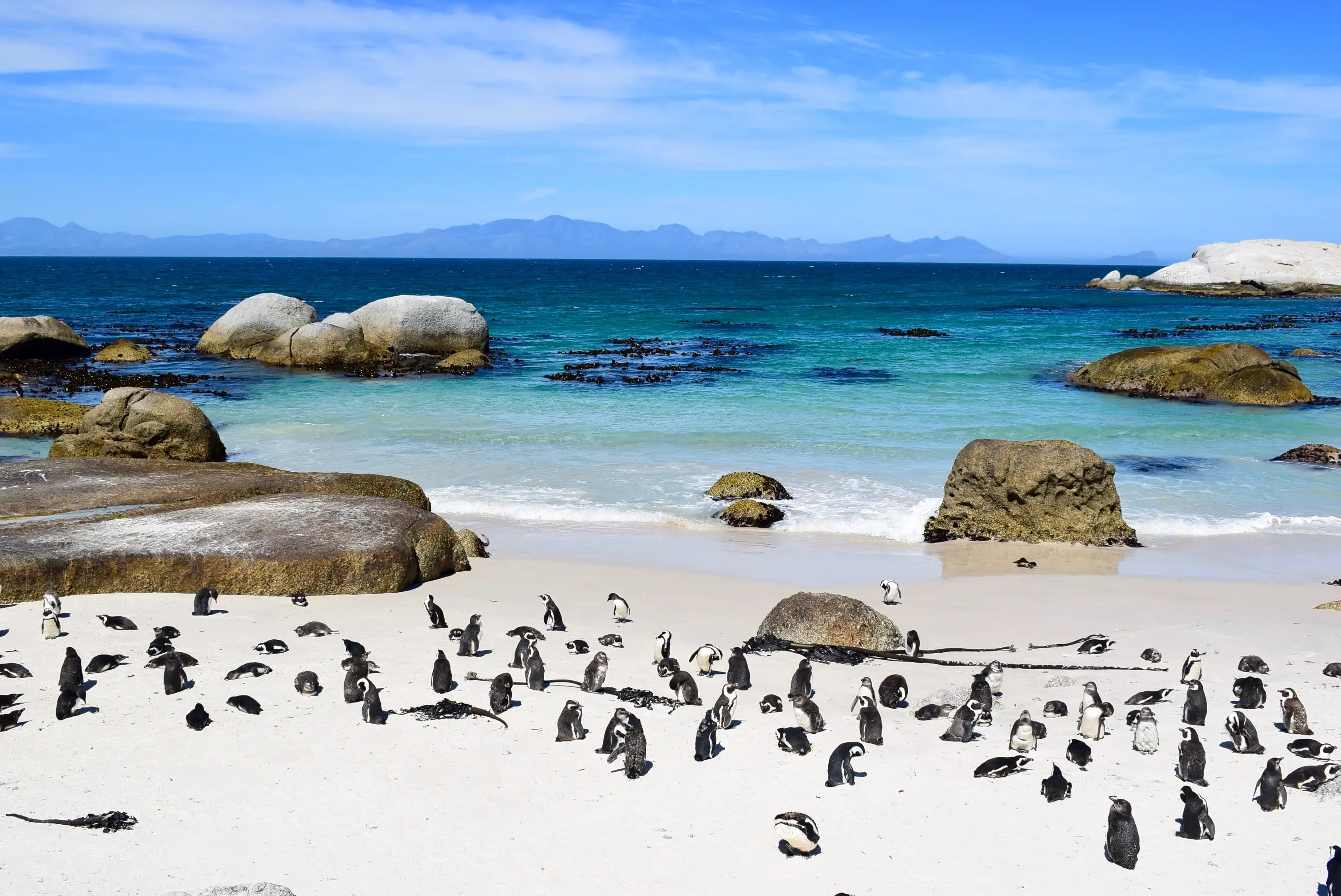
Yes. Roughly 2,000 African penguins live at Boulders Beach in Simon's Town, part of Table Mountain National Park, and the site is open daily from 08:00 to 18:30. Access carries a conservation fee of 245 ZAR per foreign adult, cashless payment only. Birds are present year-round, though numbers on the sand shift with moulting season and midday heat.
The colony did not exist before 1982. That year a single breeding pair settled on the granite boulders at Simon's Town, and the group grew into one of the few mainland African penguin populations anywhere on the coast. Everywhere else, the species clings to offshore islands. This makes the Cape Peninsula site unusual: visitors walk a raised boardwalk through fynbos and arrive metres from wild seabirds that are otherwise almost impossible to see without a boat. So when travellers ask are there penguins in cape town, the honest answer involves geography. The birds are not in the city bowl, not at the V&A Waterfront, and not on Table Mountain. They are at Boulders Beach, Kleintuin Road, Simon's Town — a False Bay village on the eastern flank of the peninsula, reached by the coastal road past Muizenberg and Kalk Bay or by the Southern Line train. The Afrikaans name for the species, brilpikkewyn, translates roughly as spectacled penguin, a reference to the pink gland above each eye that flushes when the bird overheats. A second, smaller group nests around Stony Point in Betty's Bay, further east, and some Cape Peninsula landmarks tours pair the colony with Cape Point in a single loop. What the answer means for planning is straightforward. Boulders is a national park site, not a zoo, so activity follows the birds rather than a schedule: adults leave to forage, return through the surf, and rest under the milkwood scrub. The moult, usually between November and January, keeps individuals ashore for around three weeks and makes them highly visible but immobile. Breeding peaks vary. Nothing is guaranteed on any single day, which is why an early visit generally beats a rushed one. Anyone still weighing whether there are penguins in cape town worth the drive should know the population is endangered — down sharply since the 1980s — and the conservation fee funds the boardwalks and nest boxes that protect it. Details on hours, fees, transport and on-site conduct sit in the dedicated sections below; the SANParks site at https://www.sanparks.org and the park line on +27217862329 confirm anything that changes seasonally.
“Everywhere else the species clings to offshore islands; at Boulders, it walks the sand beside you.”
The best arrival window is 08:00–10:00 to ensure fewer crowds and cooler temperatures for wildlife viewing. Planning your visit for early morning provides the most consistent experience for observing the African penguin colony.
—
Reduced foot traffic creates a quieter environment for penguin spotting.
Warm, sunny, 20°C–26°C
Higher visitor numbers are common during peak holiday months.
Mild, 15°C–22°C
Moderate temperatures make for comfortable coastal conditions.
Cool, rainy, 10°C–18°C
Wildlife remains active, though weather can be unpredictable.
Verdict: The optimal time for a visit is arriving between 08:00–10:00 on a weekday during the shoulder months of April or October.
The Boulders Beach penguin colony is open to visitors daily throughout the week. These consistent hours ensure access to the site for those planning their trip to the Cape Peninsula.
The penguin colony is located at Boulders Beach in Simon's Town, approximately 45 kilometers south of Cape Town city center. The most direct approach is via car or a combination of rail and local transport.
Follow the M3 and M4 coastal roads directly to Simon's Town
Southern Line from Cape Town Station to Simon's Town Station
Direct transfer via M3 and M4 highways
Parking in the designated areas near Kleintuin Road fills quickly, so visitors are encouraged to utilize nearby public parking lots if the main site reaches capacity.
The African penguins at Boulders Beach are an endangered colony nesting in a protected SANParks reserve, and the birds are wild rather than tame. How visitors behave on the boardwalks decides whether the penguins keep breeding here or abandon their burrows.
Everything you need to know about are there penguins in cape town
Yes, there are penguins in Cape Town, specifically residing at the Boulders Beach colony in Simon's Town. This site is home to a thriving population of African penguins.
The most prominent spot to see penguins in the Cape Peninsula is Boulders Beach. It serves as a protected sanctuary for these marine birds within the Table Mountain National Park.
The best arrival window for your visit is 08:00–10:00. Arriving during this period helps you avoid the largest crowds and ensures cooler temperatures while observing the wildlife.
The conservation fee is 245 ZAR per foreign adult. Please note that the site operates on a cashless payment system.
While visitors can access the beach area, the penguins are protected wildlife and should not be touched or disturbed. You may observe them from designated viewing boardwalks or the sandy shores.
Advance planning is recommended to manage your schedule, but entrance is managed at the gate. You can verify details on the official site at https://www.sanparks.org.
The site is open daily from 08:00 to 18:30. These hours apply throughout the week, including weekends and public holidays.
Best Penguin Tours in Cape Town
Read more GuideWhen to See Penguins in Cape Town
Read more GuideSeeing Penguins in Cape Town: Visitor Guide
Read more Tickets & toursCape Town Penguin Beach Tours
Read more Tickets & toursPrivate Penguin Tours from Cape Town
Read more Tickets & toursCape Point and Penguin Tours
Read more GuideCape Town Penguin Colony Tickets & Visitor Info
Read more